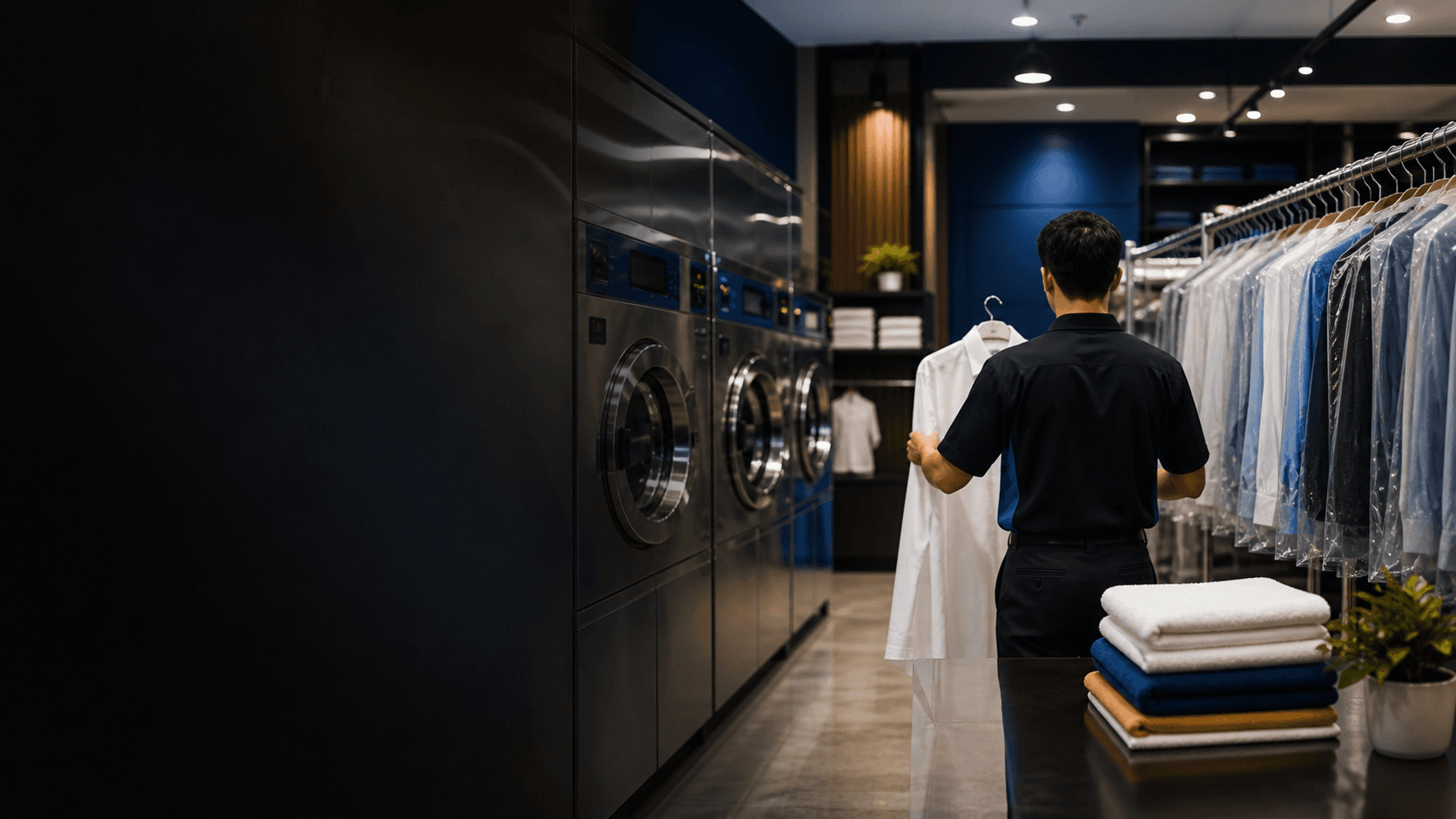














The phrase steamer professional describes a class of garment care equipment built for repeated, high-volume use rather than occasional home touch-ups. Buyers searching it in Malaysia are usually comparing vertical steamers, full-size steamers, and pro-line clothing steamers before deciding what belongs in a wardrobe, a retail floor, or a laundry operation.
What follows separates professional-grade capability from home-unit convenience, explains where steaming fits against ironing and washing, and lists the features that decide whether a unit earns its place. Specifications, prices, and warranty terms for Malaysian stock are not asserted here because the supplied evidence does not verify them.
What separates a professional steamer from a home unit
The dividing line is duty cycle, not appearance. A home garment steamer is built for a few garments at a time and then a rest. A professional steamer is built to keep producing steam across a working session, which is why the features that matter most are the ones that govern sustained output.
Steam quality and steam efficiency come first. Steam quality describes how consistently the unit delivers usable steam to the fabric; steam efficiency describes how much of the tank's contents becomes working steam rather than condensation. A unit that loses pressure after ten minutes is a home unit wearing professional styling.
Tank capacity and steam duration are the practical expression of that difference. A larger reservoir with a longer working duration means fewer refill interruptions, which matters when a rack of uniforms, coats, or baju kurung is waiting. Water control follows closely. spitting, dripping, or uneven moisture output can leave marks on fabric that then need a second pass.
Temperature control and safety features separate equipment that can be left running in a working area from equipment that needs constant supervision. Ergonomics and accessories decide whether the unit is actually used or quietly abandoned in a corner.
Professional steamer use across garment care and laundry work
Steaming is a finishing and refreshing method. It relaxes fibres with moisture and heat so wrinkles fall out, and it lifts surface odour without a full wash cycle. That makes it useful in three recurring situations.
The first is between-wear refresh for garments that are not soiled but no longer crisp: jackets, blazers, coats, trousers, and formal pieces that should not be washed after every outing. The second is finishing after cleaning, where a garment has been laundered or dry cleaned and needs its shape and drape restored. The third is volume handling in a commercial setting, where a rack of uniforms or banquet linen needs to move through finishing quickly.
Steaming does not replace cleaning. It does not remove oil-based stains, embedded soil, or the kind of soiling that requires detergent, solvent, or water. A garment with visible staining still needs laundering or dry cleaning first; steaming is what happens after, or between, those cycles.
For households and businesses in Kuching and Miri, that division of labour is often the more useful question than which unit to buy. Sinar Saredah Sdn Bhd has provided laundry and dry cleaning services in Sarawak for more than 38 years, covering wash, dry, iron, pressing, dry cleaning, and household items such as curtains, comforters, and carpets. A professional steamer handles the finishing and refresh layer; the cleaning itself is a separate service decision.
How professional steaming compares with ironing and washing
Ironing presses fabric flat against a heated plate. That produces a sharp crease and a crisp finish, and it works well on cotton shirting, linen, and anything that benefits from a defined edge. The trade-off is contact. heat and pressure sit directly on the fabric, which is why delicate weaves, embellished pieces, and some synthetics carry risk.
Steaming works without contact. The garment hangs and steam passes through it, which suits structured tailoring, knitwear, velvet, sequins, and fabrics that would flatten or shine under an iron. The trade-off runs the other way: steaming produces a softer finish and does not create a hard crease, so a starched shirt collar is still an ironing job.
Washing is a different category entirely. It removes soil and odour through water, detergent, and agitation, and it is the only one of the three that cleans. Steaming refreshes and finishes; ironing finishes and shapes. Choosing between them is a question of what the garment needs, not which method is better.
In practice, most wardrobes and most commercial operations use all three. The professional steamer earns its place where volume, delicate fabrics, or speed matter more than a pressed edge.
Features readers weigh before choosing a professional steamer
The competitor review set identifies ten features that decide whether a unit suits professional use. They are listed here in the order that review presents them, without attaching specifications, because the supplied evidence does not verify wattage, capacity, or duration figures for any model in the Malaysian market.
- Steam quality — how consistently usable steam reaches the fabric across a session.
- Steam efficiency — how much of the water drawn becomes working steam rather than condensation.
- Tank capacity and steam duration — how long the unit runs before a refill interrupts the work.
- Water control — whether output stays even or spits and drips onto the garment.
- Portability, mobility, and stability — whether the unit can be moved and whether it stays upright while in use.
- Temperature control — whether heat output can be adjusted for different fabrics.
- Ergonomics — how the unit handles during long finishing sessions.
- Accessories — attachments such as brushes, crease clamps, and steaming pads that extend what the unit can do.
- Warranty — the terms that apply if the unit fails under regular use.
- Safety features — the protections that allow the unit to run in a working space.
Two of these deserve more weight than the rest for professional use. Steam duration determines how the work is paced; a unit that needs refilling mid-rack changes how a session is organised. Water control determines rework; a unit that marks fabric creates a second job instead of finishing the first.
Accessories are the most commonly underestimated item. A brush attachment helps lift surface debris from heavier fabrics, a crease clamp creates a defined line where one is wanted, and a steaming pad gives a stable surface for pressing against. These change what a single unit can handle.
Steamer professional questions answered before purchase
Does a professional steamer replace dry cleaning? No. Steaming refreshes and finishes; it does not remove oil-based stains or embedded soil. Garments that need cleaning still need cleaning.
Is steaming safe on every fabric? No. Most fabrics handle steam well, but heat sensitivity varies, and unverified claims about bacteria or deep dirt removal should not be treated as a reason to choose one unit over another. Fabric care labels remain the reliable guide.
What water should go into a steamer? The competitor review set discusses distilled water use. Mineral-heavy tap water can leave deposits inside the unit over time, which affects output. The specific recommendation for any model should come from that model's own documentation.
Can a home unit do professional work? Occasionally, for low volume. The limit appears when a session runs long enough that refilling, cooling, or inconsistent output interrupts the work. That is the point at which professional-grade equipment starts to pay for itself.
Where does steaming fit alongside a laundry service? Steaming handles the finishing and between-wear refresh layer. Cleaning, stain treatment, and volume laundering sit with a laundry and dry cleaning provider. Sinar Saredah Sdn Bhd operates in Kuching and Miri and can be reached at 0176325699 for laundry, dry cleaning, and specialist cleaning enquiries.
For buyers in Malaysia, the practical sequence is to decide what the unit will actually be used for, then weigh the ten features against that use. A unit chosen for steam duration and water control will serve a working wardrobe or a commercial rack better than one chosen on appearance alone.