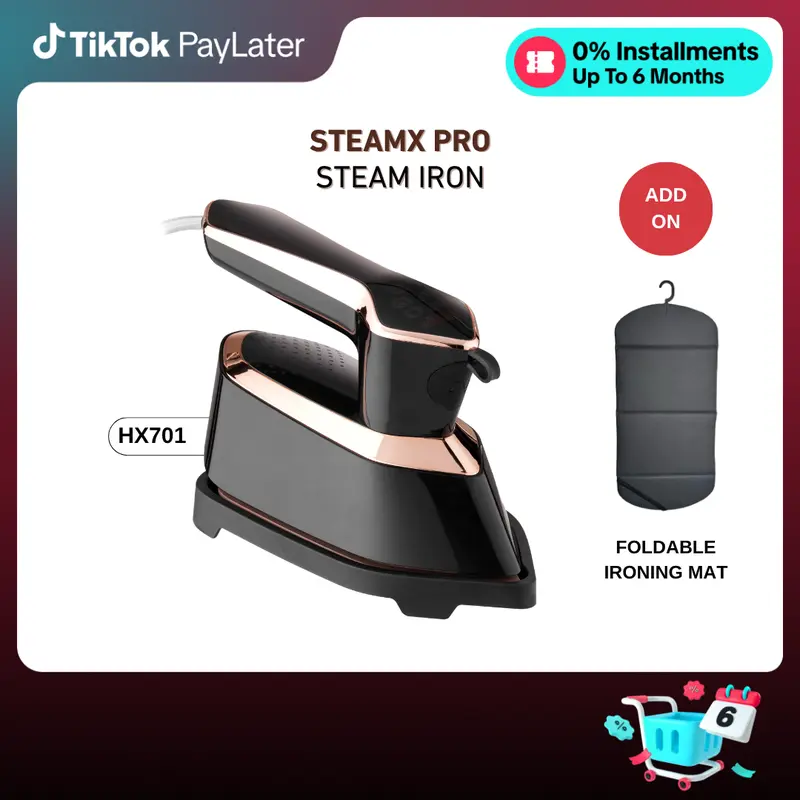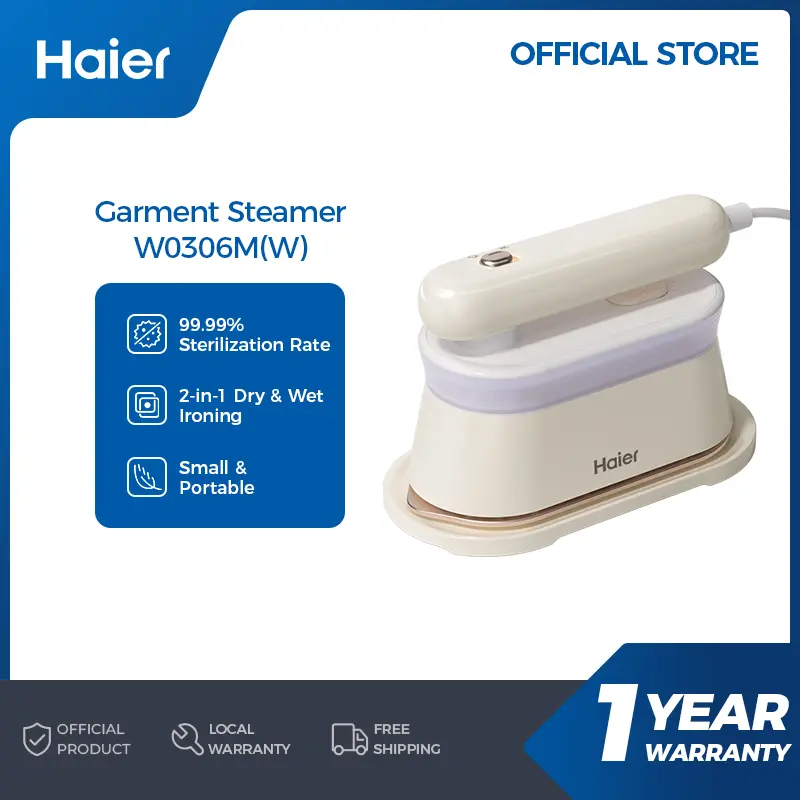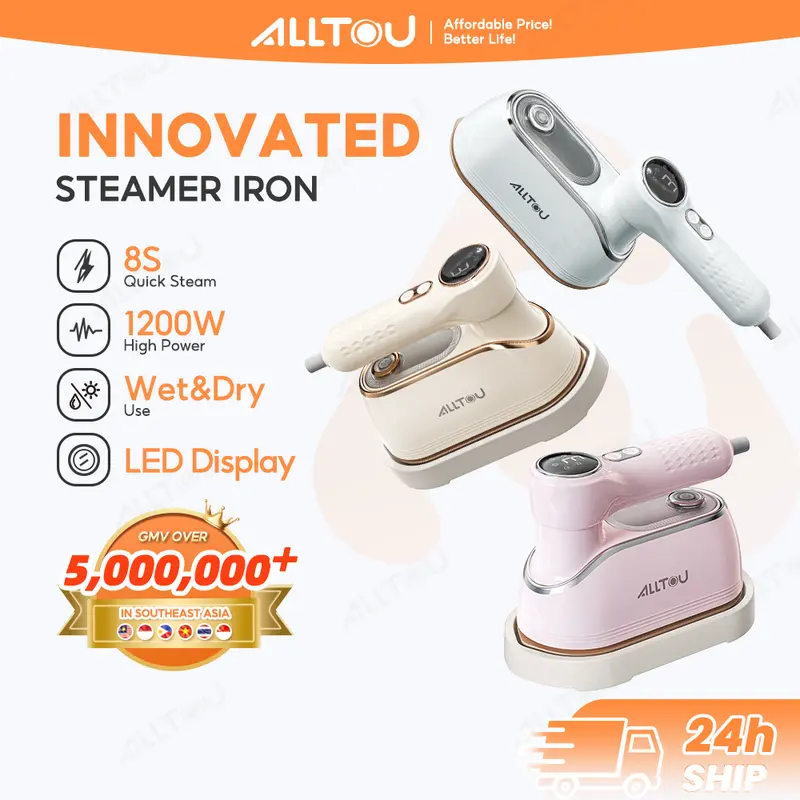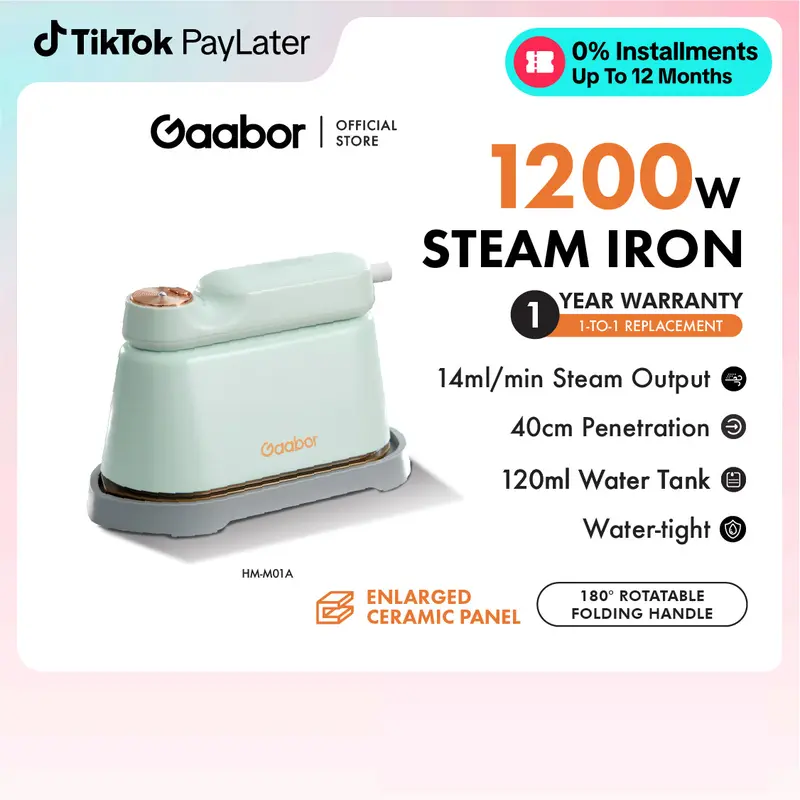














The cordless iron for clothes is a small appliance built around one trade: the soleplate carries heat for a short working window, then returns to a charging base to recover. That single design choice changes how a garment is pressed, where the base sits, and how much of a shirt can be finished before the iron goes back on its stand.
Malaysian homes often press baju kurung, school uniforms, office shirts, and bedsheets in one sitting. A corded iron keeps working as long as the socket allows. A cordless model asks for a different rhythm: press, return, wait, press again. Whether that rhythm suits a household depends on how much ironing happens at once and how much space the base can occupy.
Cordless Iron For Clothes. What the Cordless Design Changes
The cord is the only thing removed. Everything else in the appliance still exists: a soleplate, a thermostat or temperature dial, a water tank on steam models, and a handle. Removing the cord removes the tether to a wall socket, and it also removes the continuous power supply that a corded iron draws while in use.
That is the core trade-off. A corded iron can be used for as long as the user keeps moving it. A cordless iron works in cycles, because the soleplate has to return to the base to recover the heat it loses against fabric. The base stays plugged in; the iron itself does not.
Two consequences follow. First, the iron is lighter in the hand, because no cord pulls at the wrist and no cable weight hangs off the back. Second, the pressing motion becomes freer, since the iron can be rotated, lifted, and set down at any angle without a cable catching on the board or the garment.
Dry irons and steam irons both appear in cordless form. A dry cordless iron relies on soleplate heat alone. A cordless steam iron adds a water tank and steam output, which means the tank travels with the iron and the steam supply depends on what is in that tank.
How a Charging Base Keeps a Cordless Iron for Clothes Ready
The charging base is the anchor of the whole system. It stays connected to a power source and holds the iron when the iron is not in the hand. Between passes, the iron rests on the base and the soleplate recovers heat.
This is why base placement matters more than it does with a corded iron. The base has to sit within easy reach of the ironing board, on a stable surface, and clear of the garment being pressed. If the base is too far away, every return trip costs time and the rhythm of the work breaks down. If the base sits on an unstable surface, the iron can be knocked off it.
Reheat behaviour is the practical question. A cordless iron loses heat while it works, because the soleplate is transferring energy into fabric and into moisture in the fabric. The base restores that heat. How long the iron holds usable heat, and how long it needs on the base, depends on the model and cannot be stated as a fixed figure without the manufacturer's own specification.
What can be said is the shape of the habit. Short pressing tasks suit a cordless iron well, because the iron rarely runs out of heat before the job is done. Long, continuous pressing of large items such as bedsheets or curtains asks for more returns to the base, and the work takes on a stop-start pattern.
Fabric Temperature Settings and Steam on a Cordless Iron for Clothes
Temperature settings work the same way they do on a corded iron. The dial or control selects a heat level, and the fabric determines which level is appropriate. The difference is that a cordless iron's soleplate temperature can drift downward during a long pass, so the setting is a target rather than a constant.
Steam adds a second variable. On a cordless steam iron, the water tank is part of the iron, so steam output depends on the tank having water and on the iron being hot enough to convert it. A dry cordless iron has no tank and no steam, which makes it simpler to maintain but less useful on heavy creases in thick fabric.
Fabric-to-setting relationships follow general garment care practice rather than any single brand's chart. The table below reflects the conventional direction of travel: heavier, more heat-tolerant fabrics take higher settings, and delicate fabrics take lower ones.
| Fabric type | Typical temperature setting | Steam normally used |
|---|---|---|
| Linen | High | Yes, often with moisture |
| Cotton | High | Yes |
| Wool | Medium | Yes, often with a pressing cloth |
| Silk | Low | Usually dry or with a cloth |
| Synthetic fabrics | Low | Usually dry |
Two edge cases deserve attention. Delicate fabrics such as silk and synthetics can be marked by a soleplate that is too hot, and a cordless iron that has just come off the base may be at its hottest. Letting the iron settle for a moment before touching a delicate garment reduces that risk. Wool responds better to steam and a pressing cloth than to direct high heat.
Garment care labels remain the final authority. Where a label gives a specific instruction, that instruction overrides any general table.
What to Check Before Buying a Cordless Iron for Clothes in Malaysia
Buying decisions in Malaysia involve a few practical questions that a product listing rarely answers directly. The checks below are the ones that affect daily use rather than showroom appeal.
- Confirm whether the model is a dry iron or a steam iron, since a dry cordless iron cannot produce steam at all.
- Check the water tank arrangement if steam matters, including how the tank is filled and whether it is removable.
- Look at the soleplate shape and finish, because a narrow or pointed soleplate reaches between buttons and along seams more easily.
- Confirm the base is included and understand how the iron sits on it, since the base is not optional equipment.
- Check the plug type and voltage marking against Malaysian household supply before purchase.
- Read the manufacturer's own care and cleaning instructions, because soleplate cleaning methods differ between finishes.
- Consider how much ironing happens in one session, since long sessions suit a corded iron better than a cordless one.
The last point is the one most often overlooked. A household that presses two or three garments at a time will rarely notice the reheat cycle. A household that presses a week of uniforms and bedding in one evening will notice it constantly.
Storage is the other constraint. A cordless iron needs somewhere to keep the base, and the base takes up counter or board space that a corded iron does not. In a small kitchen or utility area, that space is a real cost.
Cordless Iron for Clothes Care, Water, and Storage Habits
Routine care for a cordless iron follows the same logic as care for any iron, with one addition: the base is part of the appliance and needs attention too.
- Empty the water tank after use on steam models, so standing water does not sit in the tank between sessions.
- Let the soleplate cool fully before wiping it, and follow the manufacturer's cleaning method for the specific finish.
- Rest the iron on its base rather than on the soleplate, so the plate is not scratched by the board surface.
- Keep the base on a stable, dry surface and clear of the garment being pressed.
- Check the base contacts and the iron's matching surfaces stay clean, since the base is what restores heat.
- Store the iron and base together once cool, so the pair stays complete and the base is not misplaced.
Water quality is worth a mention. In areas with harder water, mineral deposits can build up inside a steam iron's tank and steam vents over time. Using the water type the manufacturer recommends, and following any descaling instruction in the manual, is the reliable approach. No specific descaling schedule can be given without the manufacturer's own guidance.
Auto shut off is a feature that appears on some irons, corded and cordless alike. Where a model has it, the manufacturer's manual describes how it behaves and how the iron is restarted. It should not be assumed to be present on every cordless model.
Cordless Iron for Clothes. Common Questions Answered
Does a cordless iron stay hot the whole time? No. The soleplate loses heat as it presses fabric and recovers heat on the base. The working pattern is a cycle rather than a continuous supply.
Can a cordless iron be used without the base? No. The base is what restores the soleplate's heat, so the iron depends on it for continued use.
Is a cordless steam iron better than a dry cordless iron? It depends on the fabric mix. Steam helps with heavy creases in cotton and linen. A dry cordless iron is simpler to maintain and suits light pressing and delicate fabrics.
Is a cordless iron suitable for a full week of family ironing? It can be, but the reheat cycle adds time across a long session. A corded iron avoids that interruption entirely.
What should be checked on a cordless iron before first use? The manufacturer's manual, the plug and voltage marking, the water type for steam models, and the correct resting position on the base.
For households in Kuching and Miri that would rather not press garments at home at all, Sinar Saredah Sdn Bhd has provided laundry and dry cleaning services in Sarawak for more than 38 years, with wash-and-iron and pressing-only options priced per piece or per kilogram. The company can be reached at 0176325699.