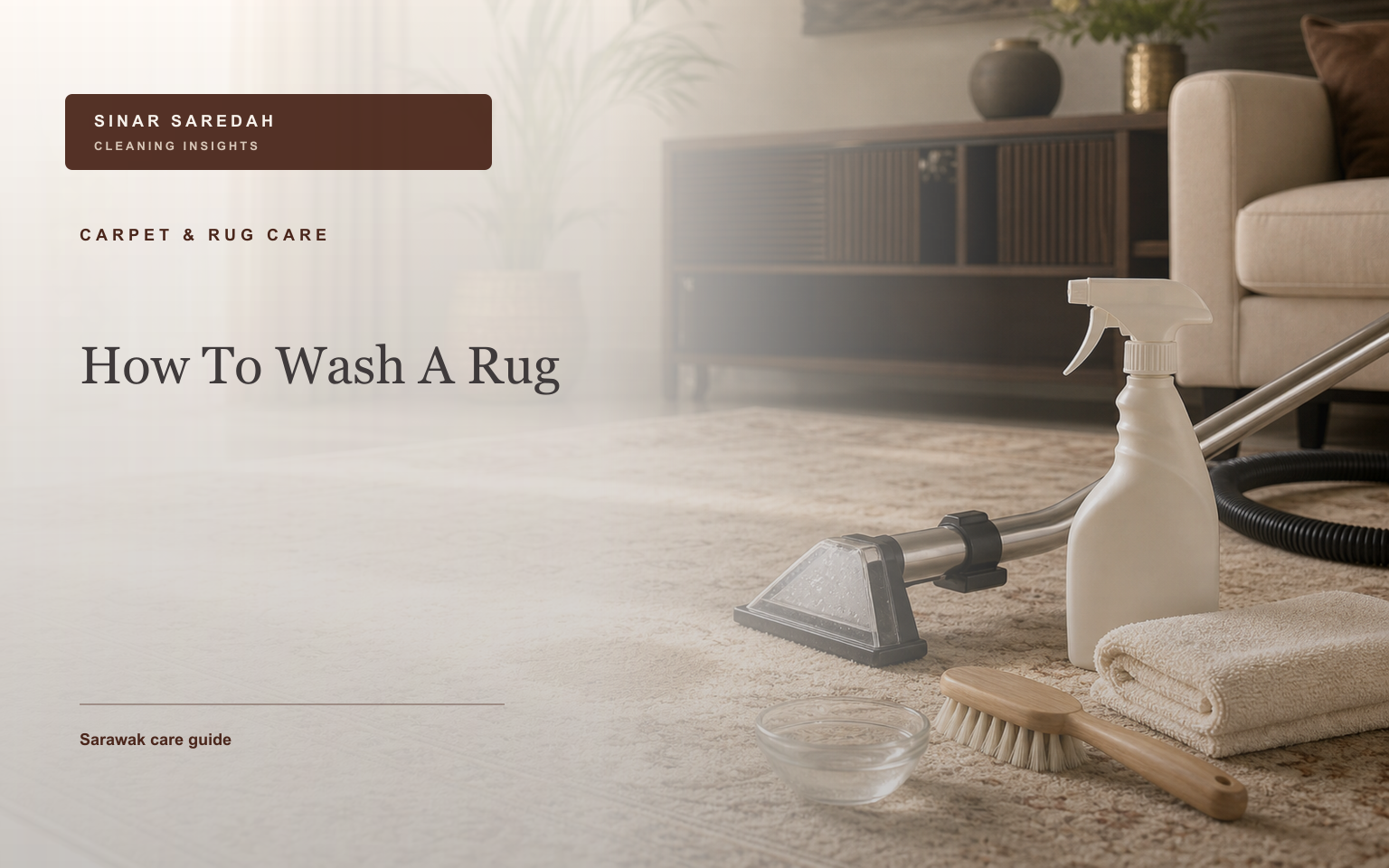
how to wash a rug: A Step-by-Step Guide
Wash A Rug safely by matching the method to the fibre: most synthetic and cotton rugs tolerate water and mild detergent, while wool, jute, viscose and rubber-backed rugs need gentler handling or professional cleaning.
The exact-match query "how to wash a rug" hides a decision, not a single technique. Two rugs of the same size can demand opposite treatment because fibre, backing and dye stability decide whether water helps or ruins the piece. Sinar Saredah Sdn Bhd, a laundry and dry cleaning provider in Kuching and Miri with more than 38 years serving Sarawak, cleans carpets and rugs as part of its household and specialist work, which is why fibre identification comes before any bucket or machine.
How to wash a rug. the decision sequence
Work through these checks in order. Each answer removes a rug from the wrong method before cleaning starts, which is cheaper than reversing dye bleed or a shrunken wool pile.
- Read the care label and note the fibre, backing and any "dry clean only" instruction.
- Confirm the rug is small enough to handle wet without dragging or folding under its own weight.
- Test a hidden corner with the detergent solution and blot with a white cloth to check for colour transfer.
- Vacuum both faces to lift loose grit before any liquid touches the pile.
- Treat stains separately with a small amount of solution rather than soaking the whole rug.
- Choose the method. machine wash for labelled machine-washable rugs, hand wash in a bath for mid-size pieces, or surface cleaning for wool, jute and viscose.
- Rinse until the water runs clear, because detergent residue attracts new dirt.
- Remove water by pressing with towels or a wet vacuum rather than twisting the rug.
- Dry flat or over a rail with air on both faces, away from direct sun and heat.
- Vacuum or brush the pile once fully dry to lift flattened fibres.
What to prepare before starting
Preparation decides whether the wash is controlled or chaotic. A rug that is too wet to lift, or too heavy to rinse, usually ends up folded, and folded wet fibre creases permanently.
Gather a vacuum, a soft brush, white towels or absorbent cloths, a mild liquid detergent without bleach or optical brighteners, and a drying space with airflow. Clear furniture from the rug and roll it rather than dragging it across the floor. For a machine wash, confirm the drum can hold the rug loosely; an overloaded drum cannot rinse properly and stresses the backing.
Colour testing matters most on hand-dyed, vintage and red-heavy rugs. A small corner test with a white cloth shows whether dye moves. If colour transfers, stop and treat the rug as a professional cleaning item.
Fibre and backing decide the method
Fibre is the single strongest predictor of whether a rug survives water. The table below groups common constructions by what they tolerate.
Rug type
|
Water tolerance
|
Practical method
|
Polypropylene, polyester, nylon
|
High
|
Machine wash on a gentle cycle or hand wash; air dry
|
Cotton and flatweave
|
Moderate to high
|
Hand wash or gentle machine cycle; dry flat to hold shape
|
Wool and wool blends
|
Low
|
Surface clean or hand wash cold with wool-safe detergent; never agitate
|
Jute, sisal, seagrass
|
Very low
|
Dry methods only; moisture causes rot, browning and shrinkage
|
Viscose, rayon, art silk
|
Very low
|
Professional cleaning; water marks and pile distortion are common
|
Rubber or latex backing
|
Low
|
Surface clean; machine washing can crumble the backing
|
Hand-knotted wool or silk
|
Low
|
Professional cleaning to protect dyes, fringe and foundation
|
Backing is the second constraint. A rubber or latex backing that breaks down in a washer leaves crumbs across the drum and shortens the rug's life. Fringe is a third. cotton fringe can be washed, but silk or hand-knotted fringe tangles and should be cleaned by hand or by a specialist.
Machine washing, hand washing and surface cleaning
Machine washing suits rugs labelled machine-washable and small enough to move freely in the drum. Use cold water, a gentle or delicate cycle, a mild detergent and an extra rinse. Skip the spin at high speed, because uneven spin distorts shape. Air dry flat or over a rail; a tumble dryer's heat is the most common cause of backing failure and shrinkage.
Hand washing suits mid-size rugs that fit in a bathtub. Fill with cool water, add a small amount of mild detergent, and work the solution through the pile with a soft brush or by pressing with the hands. Rinse with clean water until no suds remain, then press out water with towels. Lifting a soaked rug by one corner stretches the weave, so support it from underneath.
Surface cleaning suits wool, jute, viscose and any rug with a fragile backing. Vacuum first, then apply a small amount of solution to a cloth and work it into the pile in sections, blotting rather than soaking. Rinse by blotting with a damp cloth and dry with airflow. This method removes surface soil and spots without saturating the foundation.
Practical limits and precautions
Some rugs should not be washed at home at all. Hand-knotted wool and silk, antique or vintage pieces, viscose and art silk, jute and sisal, and any rug with a rubber backing carry a real risk of dye bleed, shrinkage, browning or backing failure. For these, professional cleaning is the lower-risk route.
Water temperature is a common mistake. Hot water sets some stains and accelerates dye movement, so cool water is the safer default. Detergent choice matters too. bleach, optical brighteners and strong alkaline cleaners dull wool and can yellow viscose. Over-wetting is the third risk, because a rug that stays damp for days develops odour and mildew, particularly in humid conditions.
Drying is where many home washes fail. A rug needs airflow on both faces, and a damp rug laid flat on a non-breathable floor traps moisture underneath. Raise it on a rack or dry it outdoors in shade, turning it once. Direct sun fades dyed fibres, so shade is preferable even though it takes longer.
Where a rug is too large, too delicate or too valuable to handle, professional cleaning removes the guesswork. Sinar Saredah cleans carpets and rugs alongside its laundry and dry cleaning work, with carpet cleaning priced from RM 100.00 to RM 150.00 for small pieces and RM 200.00 to RM 350.00 for larger ones, excluding 8% SST. The company operates in Kuching and Miri and opens daily from 7am, including public holidays.
Keeping the results consistent
Frequency depends on traffic and household conditions. High-traffic living areas and homes with pets or young children usually need vacuuming weekly and a deeper clean once or twice a year. Low-traffic bedrooms tolerate longer intervals. Rotating a rug periodically evens out wear from footfall and sunlight.
Between washes, vacuum both faces, blot spills immediately rather than rubbing, and use a doormat to reduce tracked grit. Store clean, fully dry rugs rolled rather than folded, with a breathable cover, because folded creases and trapped moisture cause the damage that a later wash cannot reverse.
For rugs that fall outside safe home washing, Sinar Saredah Sdn Bhd can be reached at 0176325699 to arrange carpet and rug cleaning in Kuching and Miri.