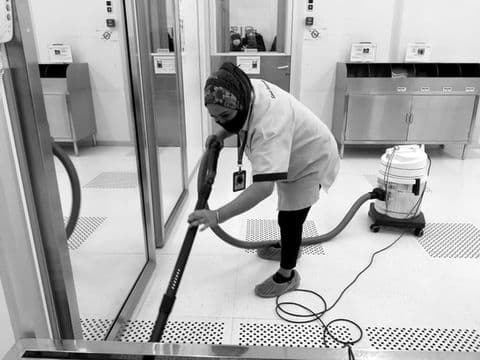
Sinar Saredah Supports IRIX Sarawak with Data-Centre-Aware Site Cleaning
For IRIX Sarawak, cleaning is not just about making the office look presentable. In a data centre and technology-driven environment, cleanliness supports uptime, staff productivity, equipment care, dust control, safety, and professional confidence.
A technical facility has different cleaning needs from an ordinary office. Dust cannot be treated casually. Water usage must be controlled. Cleaning tools must not create unnecessary static. Work must be done without disturbing sensitive equipment, access-controlled rooms, cable routes, raised floors, server-adjacent spaces, and operational teams.
Sinar Saredah Sdn Bhd supports IRIX Sarawak with a structured site cleaning programme designed for both office productivity and technical facility standards. The scope includes office cleaning, shared-space hygiene, meeting room care, surface sanitisation, dust control, HEPA-filtered vacuuming, anti-static cleaning practices, low-moisture floor care, and environmentally mindful cleaning products.
The goal is simple: help IRIX maintain a clean, professional, and technically responsible working environment.
The Challenge: Cleaning Around a Technical Environment
In a data centre environment, one of the biggest cleaning challenges is invisible dust.
Fine dust can settle on desks, vents, cable trays, floor edges, equipment rooms, and hard-to-reach corners. If removed incorrectly, it can become airborne again. In normal offices, this may only affect appearance. In a technical facility, it becomes a bigger concern because dust can affect indoor air quality, equipment surroundings, and the overall impression of operational discipline.
The team also had to work around access controls. Some areas required permission before entry. Some spaces could only be cleaned under supervision. Some zones required dry or low-moisture methods. The cleaning team had to understand when to clean, where to clean, and what not to touch.
Another challenge was workflow. IRIX staff needed to continue working. Meeting rooms, office spaces, corridors, technical support areas, and shared facilities could not be blocked for long periods. Cleaning had to be planned around the site’s operating rhythm.
What Sinar Saredah Did
Sinar Saredah began with a site walkthrough to identify different zones and cleaning requirements. The site was separated into practical cleaning categories:
Zone
| Cleaning Focus
|
|---|
Office areas
| Dusting, vacuuming, bin clearing, desk hygiene
|
Meeting rooms
| Presentation readiness, table cleaning, chair alignment
|
Shared spaces
| High-touch sanitisation, floor care, pantry hygiene
|
Technical-adjacent areas
| Dust control, careful wiping, HEPA vacuuming
|
Corridors and access routes
| Floor cleaning, mark removal, safety
|
Washrooms
| Hygiene cleaning, odour control, consumable checks
|
Restricted zones
| Cleaning only with approval and according to site rules
|
This zoning system helped the team avoid a general cleaning approach. Instead, each area received the right method.
For technical spaces, the team used controlled cleaning techniques. Staff avoided direct spraying near sensitive surfaces. Chemicals were applied onto cloths first before wiping. Microfiber and lint-controlled materials were used to capture dust instead of spreading it. HEPA-filtered vacuuming was used for fine particles, especially along edges, under workstations, and around low-traffic corners where dust often accumulates.
For normal office areas, the team carried out daily and periodic cleaning. This included vacuuming, mopping, surface wiping, sanitising shared contact points, cleaning glass panels, maintaining pantry areas, and keeping meeting rooms ready for use.
Businesses with similar technical-office requirements can also review Sinar Saredah’s office and commercial cleaning support.
Machinery and Tools Used
For IRIX Sarawak, the cleaning team used a combination of commercial and technical-friendly cleaning equipment.
The main equipment included:
Equipment
| Purpose
|
|---|
HEPA-filtered vacuum cleaners
| Fine dust removal from carpets, corners, edges, and technical-adjacent areas
|
Backpack vacuum units
| Quiet and efficient cleaning in office spaces
|
Wet and dry vacuum machine
| Controlled clean-up for utility and hard-floor areas
|
Low-speed rotary machine
| Deep cleaning and buffing of selected hard floors
|
Walk-behind scrubber dryer
| Larger corridor and hard-floor maintenance
|
Microfiber flat mop system
| Low-moisture daily floor cleaning
|
Anti-static microfiber cloths
| Surface wiping in sensitive areas
|
Lint-free wipes
| Controlled wiping for selected equipment-adjacent surfaces
|
High-reach dusting tools
| Cleaning vents, ledges, upper corners, and signage
|
Air movers
| Drying support after low-moisture floor cleaning
|
The team avoided overly wet cleaning methods near technical zones. Where wet cleaning was necessary, it was done with controlled moisture, proper signage, and drying checks.
Cleaning Materials Used
The materials were selected to balance hygiene, surface protection, and technical sensitivity.
They included:
- Neutral pH floor cleaner
- Low-residue surface cleaner
- Low-odour disinfectant
- 70% alcohol wipes for approved non-porous surfaces
- Anti-static microfiber cloths
- Lint-free wiping materials
- Glass cleaner for partitions and panels
- Stainless steel polish for selected fixtures
- Mild degreaser for pantry areas
- Colour-coded cloths and mop heads
- Disposable gloves
- Caution signage
- Controlled chemical dilution bottles
The use of colour-coded tools helped prevent cross-contamination. For example, washroom tools were separated from office tools, and pantry tools were separated from general surface cloths.
How Long the Work Took
The initial full cleaning and technical-site preparation took approximately 4 working days.
A realistic project flow looked like this:
Phase
| Duration
| Work Completed
|
|---|
Site inspection and cleaning plan
| 0.5 day
| Walkthrough, access review, zone planning
|
Office and shared area cleaning
| 1 day
| Workstations, meeting rooms, pantry, washrooms
|
Technical-adjacent dust control
| 1 day
| HEPA vacuuming, controlled wiping, edge cleaning
|
Floor and corridor maintenance
| 1 day
| Scrubbing, buffing, low-moisture mopping
|
Final detailing and quality check
| 0.5 day
| Glass, fixtures, bins, touchpoints, inspection
|
After the initial cleaning, Sinar Saredah continued with routine cleaning support. Daily work focused on hygiene and general upkeep. Weekly work focused on detailed dusting, glass, pantry care, and floor checks. Monthly work included deeper dust control, carpet care, and machine cleaning where needed.
The Result
The result was a cleaner, more controlled, and more professional working environment for IRIX Sarawak.
Office users had cleaner desks, fresher meeting rooms, more hygienic shared spaces, and better-maintained floors. Facility managers had a cleaning partner that understood the difference between normal office cleaning and technical-site cleaning. Sensitive areas were treated with care, and cleaning was done without unnecessary disruption.
For IRIX, the value was not only cleanliness. The value was confidence — confidence that the site looked professional, that hygiene was maintained, and that cleaning was carried out with awareness of the technical environment.