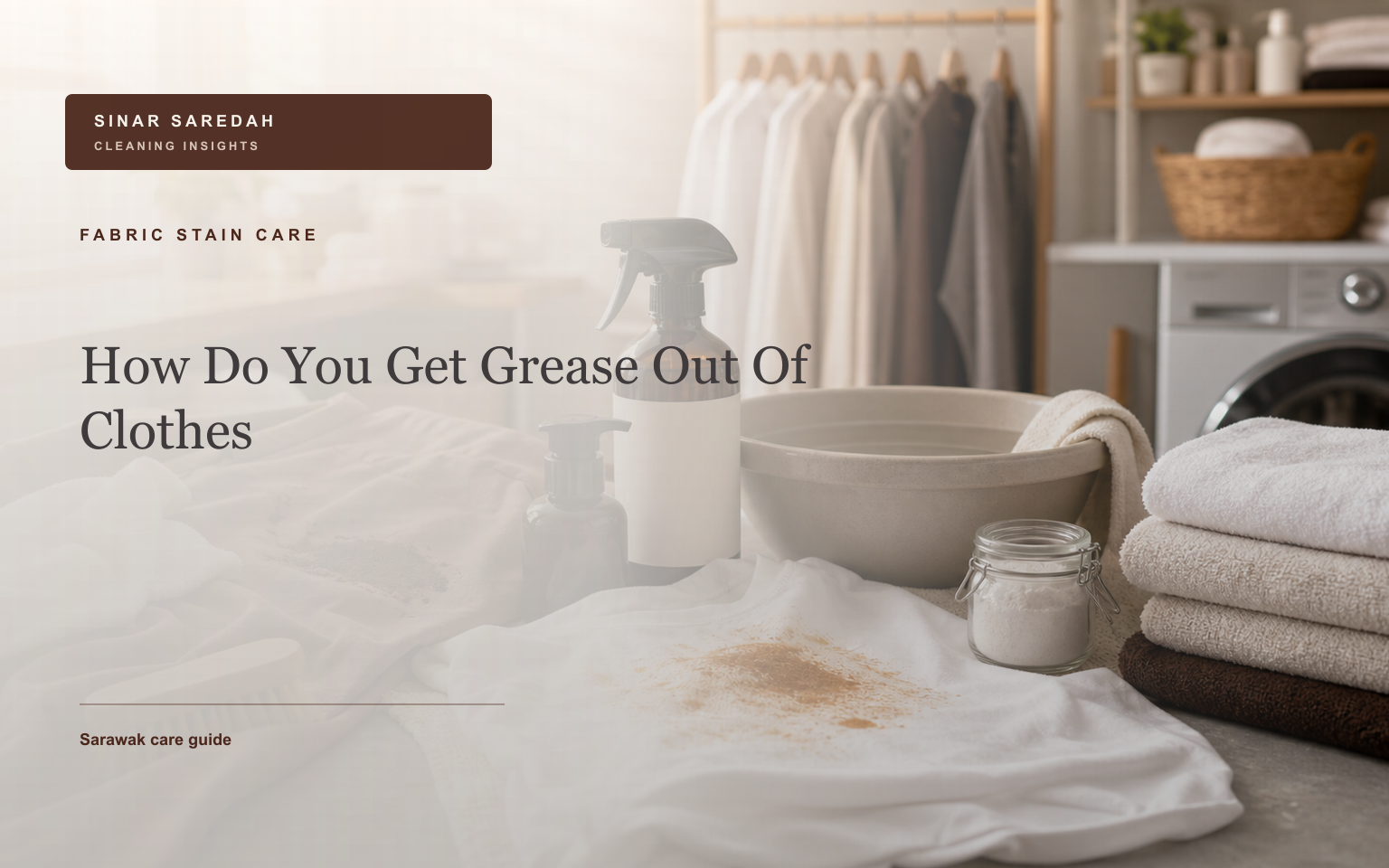
How Do You Get Grease Out Of Clothes: How It Works and Where It Fits
Getting grease out of clothes depends on absorbing excess oil first, then breaking down the residue with a grease-cutting agent before the garment is washed and air-dried.
The exact-match query how do you get grease out of clothes sits at the meeting point of two things: the chemistry of oil and the care limits of the fabric. Grease is a non-polar oil, while water is polar, so plain water alone cannot lift it. That single fact explains why every reliable method starts with absorption or a surfactant, and why heat is the enemy until the stain is gone.
How Do You Get Grease Out Of Clothes: The Sequence That Works
Most published guides converge on the same order of operations. The numbered list below reflects that shared structure rather than any single source.
- Blot or scrape off excess grease while it is still wet. Do not rub, because rubbing pushes oil deeper into the weave and spreads the stain sideways.
- Apply an absorbent powder such as cornstarch, baking soda, or baby powder and let it sit so it can pull surface oil out of the fibres.
- Work a grease-cutting agent into the stain. Liquid dish soap, laundry detergent, or a dedicated stain remover are the options most often cited.
- Let the treatment dwell rather than rinsing immediately, so the surfactant has time to surround the oil molecules.
- Wash at the warmest temperature the care label allows, using the normal cycle.
- Check the garment before drying. If any mark remains, repeat the treatment instead of moving to the dryer.
- Air-dry or line-dry the item so residual oil is not baked into the fabric by dryer heat.
The last two points matter more than they look. Heat sets oil the same way it sets a wax mark on a table, and a stain that survives one wash cycle is far easier to treat while it is still wet than after a full drying cycle.
Why Grease Stains Resist Normal Washing
Oil and water do not mix, so a standard wash cycle without pretreatment mostly moves the stain around rather than removing it. Detergents work because they contain surfactants: molecules with one end that bonds to oil and another that bonds to water. That structure lets the oil be lifted off the fibre and carried away in the rinse water.
This is also why dish soap appears in almost every guide. Dish liquids are formulated to cut cooking grease, so they carry a higher concentration of grease-targeting surfactants than many general-purpose laundry products. The trade-off is that some dish soaps are harsh on certain dyes and delicate fibres, which is why the care label still governs the final decision.
Fresh Stains Versus Set-In Stains
A fresh stain responds to absorption and a single pretreatment. A set-in stain, one that has already been through a wash and dry cycle or has sat for days, usually needs repeated treatment cycles. The mechanism is the same; only the number of repetitions changes. Older stains also tend to have oxidised, which can leave a faint yellow shadow even after the oil itself is gone.
Matching the Method to the Fabric
Fabric type changes which tools are safe, not whether the method works. Cotton and polyester tolerate warm water and firmer agitation. Wool, silk, and other protein or delicate fibres do not, because heat and friction can shrink, felt, or distort them.
Fabric type
|
Water temperature
|
Agitation
|
Main risk
|
Cotton
|
Warm to hot, per care label
|
Normal cycle
|
Dye fading with repeated hot washes
|
Polyester and synthetics
|
Warm
|
Normal cycle
|
Oil bonds tightly to synthetic fibres
|
Wool and knits
|
Cool
|
Gentle, minimal rubbing
|
Shrinking and felting from heat and friction
|
Silk and delicates
|
Cool
|
Hand treatment only
|
Water spotting and fibre damage
|
For the delicate end of that table, hand treatment with a mild solution and a cool rinse is safer than a machine cycle. Where the garment is structured, lined, or heavily embellished, the risk of home treatment rises and professional dry cleaning becomes the more sensible route.
Common Grease-Cutting Agents and What Each Does
Different agents attack the problem at different stages, which is why combining an absorbent with a surfactant works better than either alone.
- Absorbent powders such as cornstarch, baking soda, and baby powder pull free oil out of the surface of the weave before any liquid is added.
- Liquid dish soap supplies a high concentration of grease-cutting surfactants and is the most frequently cited pretreatment.
- Laundry detergent works as both pretreatment and wash agent, and is gentler on dyes than many dish liquids.
- Enzyme and grease-busting stain removers are formulated specifically for oil-based marks and are useful when a stain has already set.
- White vinegar is sometimes used as a rinse aid, though it addresses residue and odour more than the oil itself.
One practical constraint applies across all of them: more product is not better. Excess soap left in the fabric can attract new oil and leave a dull patch, so thorough rinsing matters as much as thorough treating.
When Home Treatment Is Not the Right Answer
Some garments should not be treated at home at all. Structured jackets, lined coats, wedding gowns, beaded or sequinned pieces, leather and synthetic leather, and heavily soiled uniforms all carry a real risk of colour loss, shape change, or fibre damage from home washing.
In Kuching and Miri, Sinar Saredah Sdn Bhd provides laundry and dry cleaning alongside specialist cleaning for items such as curtains, carpets, wedding gowns, shoes, and soft toys, with more than 38 years serving Sarawak. Dry cleaning uses solvents rather than water, which is a better match for oil-based stains on fabrics that water would damage. For a household item rather than a garment, curtain cleaning is priced at RM 40 per kilogram, and a small carpet falls in the RM 100.00 to RM 150.00 range, with final cost depending on weight, fabric type, and condition.
For readers weighing whether a grease-stained item is worth treating at home or sending out, the deciding factors are fibre type, garment construction, and whether the stain has already been heat-set. A plain cotton shirt is a home job. A lined blazer with a grease mark on the lapel is not.
Practical Considerations for
A few constraints decide the outcome more often than the choice of product.
Time is the first. The longer oil sits in a fibre, the more it spreads and the more it oxidises. Treating a stain within the same day is materially easier than treating one found a week later.
Water temperature is the second. Warm water helps surfactants work, but only up to what the care label permits. Going hotter than the label allows risks shrinkage and dye loss that no amount of stain removal can undo.
Drying is the third, and it is the one most often skipped. Air-drying until the stain is confirmed gone costs nothing and prevents the single most common reason a grease stain becomes permanent.
Finally, repetition is normal rather than a sign of failure. A set-in stain that needs three treatment cycles is not evidence that the method is wrong; it is evidence that the oil had already bonded to the fibre.
For items that are valuable, structured, or made from a fibre that water damages, professional cleaning removes the guesswork. Sinar Saredah can be reached at 0176325699 for laundry and dry cleaning enquiries in Kuching and Miri.